Theresa May has insisted the jurisdiction of the European Court of Justice in the UK will come to an end with Brexit.
As the government published new details of its position, the PM said the UK would "take back control of our laws".
But critics say it will be impossible to avoid European judges having a role in enforcing new agreements drawn up with the EU.
Ministers say the two sides will keep "half an eye" on each other's rulings.
- Reality Check: What is the European Court of Justice?
- UK seeks 'close co-operation' on legal disputes
The ECJ is in charge of ensuring member states abide by EU law.
Its rulings are binding on all member states, and it also settles disputes between countries and EU institutions.
In its new policy paper, the government:
- Does not rule out ECJ keeping its jurisdiction during the Brexit transition period that is planned after March 2019
- Promises to work with the EU on the "arrangements for judicial supervision" during this period
- Makes clear that the rights of EU citizens living in the UK after Brexit will only be subject to British law - a sticking point in the negotiations with the EU
- Says giving the ECJ authority over UK-EU disputes would be unprecedented and not "fair and neutral"
EU court's role
The promise to end "direct jurisdiction" in recent policy papers - a phrase not used by Mrs May - has raised questions about what "indirect" jurisdiction the EU court could be left with.
In the latest publication, about how to enforce disputes after Brexit, the government has outlined several models used by other countries that it says show there is no need for the ECJ to be the final arbiter.
But some of these involve the ECJ having an influence on the outcome of disputes, for example by interpreting EU law in a way that binds a disputes panel, or for its past rulings to be taken into account.
The government said it was not committing to following any of the arrangements set out, ruling out an "off the shelf" model.
And sources played down the significance of the word "direct", saying it meant ECJ rulings would no longer automatically apply to the UK and that the court would no longer be able to strike down domestic UK laws.
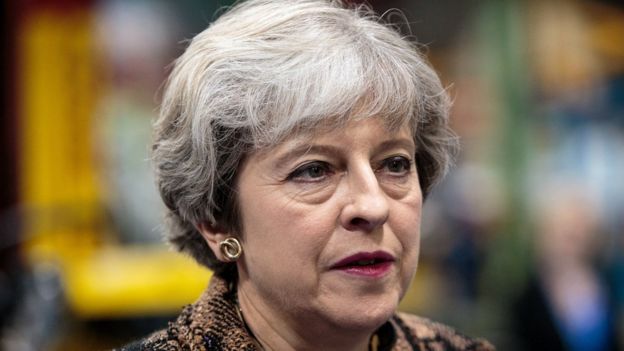
Asked about her government's position, Mrs May said: "What we will be able to do is to make our own laws - Parliament will make our laws - it is British judges that will interpret those laws, and it will be the British Supreme Court that will be the ultimate arbiter of those laws."
Earlier Justice Minister Dominic Raab said there would be "divergence" between UK and EU case law after Brexit, adding: "It is precisely because there will be that divergence as we take back control that it makes sense for the UK to keep half an eye on the case law of the EU, and for the EU to keep half an eye on the case law of the UK."
The ECJ's remit extends into many of the areas where the UK is hoping to draw up new arrangements with the EU, including trade and citizens' rights.
Mr Raab said "some form of arbitration" would be needed, but that this would not be akin to a European court.
Arbitration is where disputes are settled by a neutral third party. The UK and the EU could each appoint arbitrators and agree on a third, Mr Raab suggested.
He said this was different to the UK accepting the jurisdiction of ECJ which would be "lopsided and partisan and that's not on the cards".
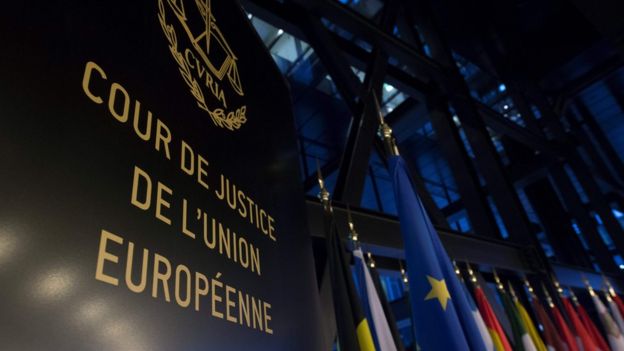
European Court of Justice
- Decides whether the institutions of the EU are acting legally, and settles disputes between them
- Ensures that the member states of the EU are complying with their legal obligations as set out in the EU treaties; and allows member states to challenge EU legislation
- Interprets EU law at the request of national courts
Pro-EU campaigners say the government made an "appalling error" by making leaving the ECJ a "red line" in Brexit negotiations, saying new courts will now be needed in all the areas it extends to, including trade, citizens' rights and security.
The pro-EU Open Britain group claimed a "climbdown" in the government's approach.
Sir Keir Starmer, Labour's shadow Brexit secretary, said: "The prime minister's ideological insistence that there can be no future role whatsoever for the ECJ or any similar court-like body risks preventing the deal Britain needs."
Liberal Democrat leader Vince Cable said Mrs May's "red lines are becoming more blurred by the day", saying the ECJ had "served Britain's interests well" and should not be "trashed".

